



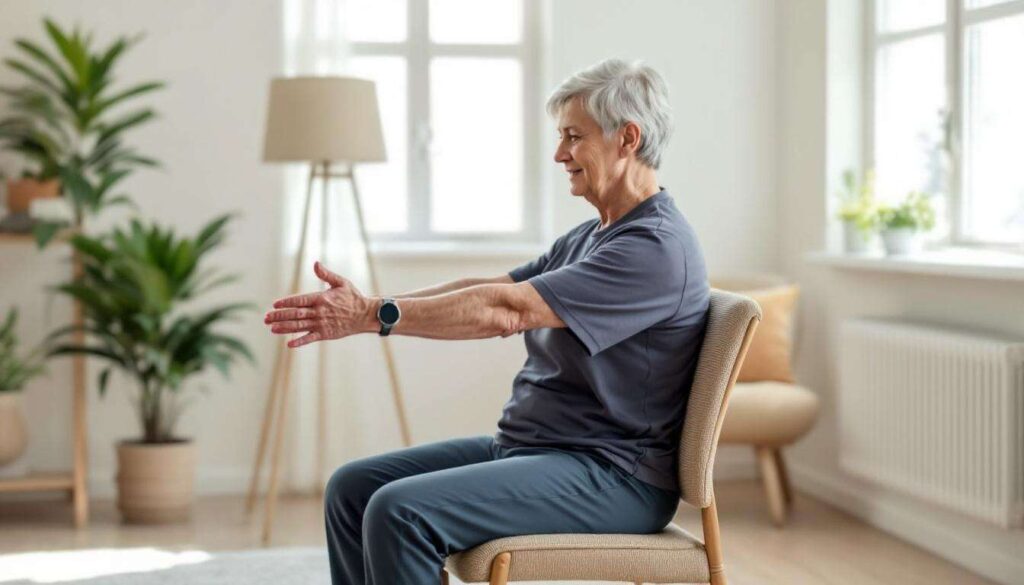
Maintaining hip strength becomes increasingly critical as we age, yet many seniors struggle with traditional exercises like squats that can strain joints and challenge balance. Physical therapists and fitness experts now recommend chair-based exercises as a safer, more effective alternative for building hip strength after 60. These seated movements target the hip muscles without the risk of falling or excessive joint stress, making them ideal for older adults looking to maintain mobility and independence. The following exercises have been specifically designed to strengthen the hip flexors, abductors, and external rotators while providing the support and stability that many seniors need.
Why strengthening hips after 60 is essential
The hip joint serves as the foundation for nearly every movement we make, from walking and climbing stairs to simply standing up from a chair. After age 60, hip muscle mass naturally declines by approximately 3-8% per decade, leading to reduced strength and increased fall risk. This condition, known as sarcopenia, affects balance, gait stability, and overall quality of life.
The consequences of weak hip muscles
Neglecting hip strength in later years can lead to several serious complications:
- Increased risk of falls and hip fractures
- Difficulty performing daily activities like getting dressed or bathing
- Reduced walking speed and endurance
- Lower back pain due to compensatory movements
- Loss of independence and mobility
Hip fractures represent one of the most serious consequences, with studies showing that approximately 20% of seniors who experience a hip fracture die within one year. Beyond mortality concerns, weak hips contribute to a cycle of inactivity that accelerates muscle loss and further diminishes functional capacity.
The role of hip muscles in daily function
Three primary muscle groups around the hips require attention: the hip flexors that lift the leg forward, the hip abductors that move the leg sideways, and the hip external rotators that turn the leg outward. Each group plays a distinct role in maintaining balance and enabling smooth, coordinated movement patterns essential for everyday tasks.
Understanding these fundamental aspects of hip health sets the stage for exploring why chair-based exercises offer particular advantages for the senior population.
The benefits of chair exercises for seniors
Chair exercises provide a unique combination of safety and effectiveness that makes them particularly valuable for older adults. Unlike standing exercises that require balance and coordination, seated movements eliminate fall risk while still delivering significant strength gains.
Safety advantages of chair-based training
The primary benefit of chair exercises lies in their inherent safety features. Seniors can focus entirely on proper muscle engagement without worrying about maintaining balance or experiencing dizziness. This psychological comfort often translates to better exercise adherence and more consistent training habits.
| Feature | Chair Exercises | Standing Exercises |
|---|---|---|
| Fall risk | Minimal | Moderate to high |
| Joint stress | Low | Moderate to high |
| Accessibility | High | Varies |
| Balance requirement | None | Significant |
Muscle activation and strength gains
Research demonstrates that seated hip exercises can activate target muscles just as effectively as standing variations. The key difference lies in the isolation: chair exercises allow for focused muscle engagement without recruiting stabilizing muscles throughout the body. This targeted approach proves especially beneficial for seniors with existing balance issues or joint conditions.
Additionally, chair exercises accommodate various fitness levels through simple modifications. Resistance bands, ankle weights, or simply increasing repetitions can progressively challenge the muscles as strength improves. This scalability ensures long-term effectiveness and continued progress.
These safety and effectiveness features naturally lead to questions about how chair exercises compare directly to traditional squat movements for hip development.
How chair exercises outperform squats for the hips
While squats have long been considered the gold standard for lower body strengthening, they present several challenges for seniors that chair exercises effectively address. The comparison reveals why many physical therapists now prioritize seated movements for their older clients.
Reduced joint compression and injury risk
Squats place significant compressive forces on the knee and hip joints, particularly during the descent phase. For seniors with arthritis, previous injuries, or reduced cartilage, this compression can cause pain and potentially accelerate joint degeneration. Chair exercises distribute forces differently, minimizing joint stress while still providing adequate resistance for muscle strengthening.
The biomechanical advantage of seated exercises becomes clear when examining force distribution: squats load the spine, hips, knees, and ankles simultaneously, while chair exercises isolate specific muscle groups with minimal impact on surrounding structures.
Better muscle isolation for targeted strengthening
Squats primarily target the quadriceps and glutes, with hip-specific muscles playing a secondary stabilizing role. Chair exercises, conversely, can directly target the hip flexors, abductors, and external rotators through specific movement patterns. This precision allows seniors to address individual weaknesses and imbalances more effectively.
- Direct targeting of hip flexors through controlled knee lifts
- Isolated activation of hip abductors via lateral leg movements
- Specific engagement of external rotators through rotation exercises
- Reduced compensation from stronger muscle groups
Furthermore, the seated position provides immediate feedback about proper form, making it easier for seniors to maintain correct alignment throughout each repetition. This awareness reduces the likelihood of developing compensatory movement patterns that could lead to injury.
With these advantages established, examining specific exercises reveals how to implement this approach effectively.
Knee lift exercise: method and benefits
The seated knee lift represents one of the most fundamental yet effective exercises for strengthening the hip flexor muscles. These muscles, including the iliopsoas and rectus femoris, play a crucial role in lifting the leg during walking and stair climbing.
Proper execution technique
To perform the knee lift correctly, sit upright in a sturdy chair with feet flat on the floor and hands resting on the sides of the seat for support. Slowly lift one knee toward the chest while maintaining an upright posture, hold for two seconds at the top, then lower with control. The movement should be smooth and deliberate, avoiding any jerking or momentum.
Key technical points include keeping the back straight against the chair, engaging the core muscles throughout the movement, and breathing naturally without holding the breath. Begin with 10-12 repetitions per leg, completing 2-3 sets with 30-60 seconds rest between sets.
Specific benefits and progressions
This exercise directly improves the ability to lift the leg during walking, reducing the shuffling gait pattern common among seniors. Regular practice enhances step clearance, decreasing trip and fall risk significantly. The strengthened hip flexors also reduce strain on the lower back by improving pelvic stability.
Progression options include adding ankle weights starting at 1-2 pounds, holding the lifted position for longer durations, or performing the movement more slowly to increase time under tension. These modifications ensure continued strength gains as fitness improves.
Building on this foundational movement, the next exercise targets a different aspect of hip function critical for lateral stability.
Hip external rotation exercise: the technique to follow
The hip external rotation exercise specifically strengthens the deep hip rotator muscles, including the piriformis and gemellus muscles. These often-neglected muscles contribute significantly to hip stability and proper walking mechanics.
Step-by-step execution guide
Sit toward the front edge of a chair with feet flat on the floor, hip-width apart. Place hands on thighs or the chair seat for support. Keeping the heel planted, slowly rotate one knee outward, moving it away from the midline of the body. Hold this externally rotated position for 2-3 seconds, then return to the starting position with control.
The movement should occur exclusively at the hip joint, with the foot remaining in contact with the floor throughout. Avoid twisting the torso or shifting weight to one side, as these compensations reduce the exercise’s effectiveness and may cause strain.
Benefits for balance and mobility
Strong external rotators improve lateral stability during walking and standing, particularly when navigating uneven surfaces or changing direction. This muscle group also helps prevent the inward collapse of the knee, a common issue that contributes to falls and knee problems in seniors.
- Enhanced stability during weight shifting
- Reduced risk of knee valgus (inward collapse)
- Improved ability to step sideways or backward
- Better hip joint centering and alignment
Perform 10-15 repetitions per leg for 2-3 sets, focusing on controlled movement rather than speed or range of motion. As strength develops, increase the hold time at the end range or add a resistance band around the knees for additional challenge.
Complementing these rotational movements, the final exercise addresses lateral hip strength essential for maintaining balance during daily activities.
Seated lateral leg lift exercise: practical guide
The seated lateral leg lift targets the hip abductor muscles, particularly the gluteus medius, which plays a vital role in preventing the pelvis from dropping during single-leg stance phases of walking.
Correct form and execution
Sit upright in a chair with feet flat on the floor and hands holding the seat edges for stability. Keeping the leg straight, slowly lift one leg out to the side, raising it 6-12 inches from the floor. The foot should remain pointing forward throughout the movement, not rotating outward. Hold the top position for two seconds, then lower with control.
Common mistakes include leaning away from the lifting leg, rotating the foot outward, or using momentum to swing the leg upward. Maintaining proper alignment ensures maximum benefit and prevents compensatory strain on other muscles or joints.
Impact on walking stability and fall prevention
Strong hip abductors prevent the Trendelenburg gait pattern, where the pelvis drops on the unsupported side during walking. This compensation increases energy expenditure and raises fall risk. Regular practice of lateral leg lifts improves single-leg balance and gait symmetry, directly translating to safer, more efficient walking patterns.
| Repetitions | Sets | Frequency | Progression timeline |
|---|---|---|---|
| 10-12 | 2-3 | 3-4 times weekly | Increase after 2-3 weeks |
Advanced variations include adding ankle weights, using resistance bands attached to chair legs, or performing the exercise more slowly to increase time under tension. These progressions maintain challenge levels as strength improves, ensuring continued functional gains.
Maintaining hip strength through these accessible chair exercises offers seniors a practical path to preserving mobility, independence, and quality of life. The combination of knee lifts, external rotations, and lateral leg lifts addresses all major hip muscle groups while eliminating the fall risk and joint stress associated with traditional standing exercises. By dedicating just 15-20 minutes three to four times weekly to these movements, older adults can significantly improve their balance, walking ability, and confidence in daily activities. The seated format makes these exercises accessible regardless of current fitness level, providing a sustainable approach to hip strengthening that supports long-term health and functional independence.